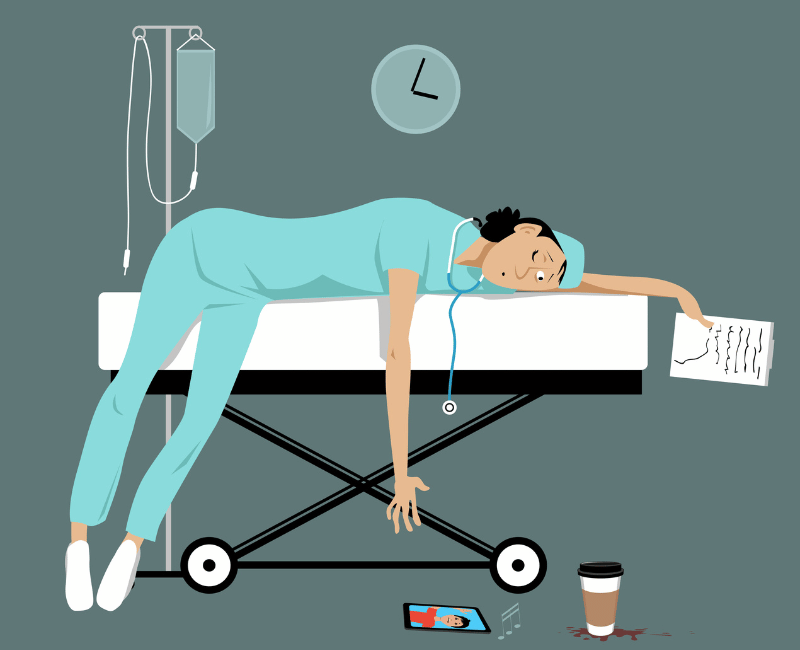
It’s been a minute since I’ve posted, partly because the last few weeks have been some of the toughest of my medical education so far. Between studying for exams, working on research, and the general chaos that seems to define med school, I hit that all-too-familiar wall: burnout. But I am back, maybe a little tired, and definitely more caffeinated (if that was even possible). Lately, I’ve been thinking less about how to avoid burnout and more about how it quietly becomes the norm, not just for students like me, but across medicine as a whole. Because if we are all this exhausted before residency even starts, what does that say about the system we are walking into?
Burnout as the Baseline
It has been a tough few weeks, the kind that remind you just how demanding medical school can be. You know – the stretch where your brain always feels full, your Google Calendar looks concerned for you, and you start answering “How are you?” with a laugh because the real answer would take too long. Between lectures, projects, clinical skills labs, and trying to maintain some resemblance of a life outside of school, I caught myself running on autopilot. Not full-blown burnout, but that quiet, persistent fatigue that settles into the cracks. What surprised me most is realizing how normal this is. Studies show that over half of medical students experience burnout, which is not exactly comforting. And despite the exhaustion, I am still grounded in the “why”: learning medicine is a privilege, and someday this knowledge will serve real people who are trusting me with their health.
Acknowledging burnout doesn’t mean I regret this path. Honestly, it’s the opposite. I love medicine enough to talk about its harder parts. Burnout isn’t a “med student problem”, it is a healthcare-wide phenomenon. Nurses, NPs, PAs, techs, residents, therapists, attendings … no one is immune. We all operate in a system that asks a lot from the people who care the most. And while I’ve adapted to the pace, I don’t want to normalize being drained as the price of this path. Gratitude and honesty can exist at the same time.
The Adaptation Cycle
Reflecting on my own learning curve over the past year and a half, I’ve noticed how quickly hard becomes normal. In the first couple months, 10-15 lectures per exam felt overwhelming; now, 30 feels manageable, which is both impressive and also a little unsettling. Medicine, without a doubt, instills endurance in those who pursue it. You adapt, stretch, and adjust until what once felt impossible becomes routine. But what medicine rarely teaches alongside endurance is recovery. The pace doesn’t slow down; you just learn to keep moving with it.
In school, every day and every week brings a new set of challenges, and “off days” are rarely feasible: there isn’t much room to pause or reboot. Most of the time, when you’re tired or overwhelmed, you simply have to keep going; not because you are superhuman, but because the pace leaves little choice. And that is where the quiet fatigue settles in. The adjustment becomes automatic, almost unconscious. One day you look up and realize you’ve trained yourself to function under conditions that would have once knocked you flat.
And this is not unique to medical students. Every role in healthcare has its version of the impossible workload. Everyone adapts to workloads that would overwhelm most people outside of the field. It becomes part of the rhythm: you show up, give what you can, and recover in whatever pockets of time you have left. The intention isn’t to call out the field, but to acknowledge the reality that loving what you do doesn’t erase the fact that the pace is demanding.
The Culture of Constant Output
In medicine, there is this unspoken pressure to always be “on”. Productivity becomes a personality trait, and rest somehow starts to feel like weakness. And the numbers reflect that reality: studies show burnout affects over half of physicians, and more than 60% of nurses report emotional exhaustion. When an entire field shows the same pattern, it stops being an individual issue and becomes a cultural one. Healthcare providers are expected to give 100% to their patients and their responsibilities, and most of them do, willingly and with pride. But constantly giving 100% eventually catches up with you, even if you absolutely love what you do. You can be fulfilled by your career and still feel drained by the pace required to succeed in it. Those two things can coexist. I know that becoming a doctor comes with delayed gratification and a long stretch of sacrifice before the reward, and I accepted that when I chose this path. But awareness doesn’t make the culture any less demanding, it just makes it clearer how important it is to talk about it, support each other through it, and advocate for a system that values sustainability just as much as dedication.
The Residency Reality (and Beyond)
Burnout doesn’t just magically disappear after medical school: it shifts, evolves, and most likely intensifies as you move through residency and into practice. Research backs this up: approximately 60% of residence experience burnout, and more recent data continues to reflect those high rates. Long hours, overnight calls, sleep deprivation, and the emotional weight of caring for real patients all stack together. It is not that residents lack resilience, it is that the demands are enormous, and the system is still catching up to what humans can realistically sustain.
I am the first to acknowledge that I haven’t experienced residency yet, nor clinical rotations for that matter, but I am not naive to what lies ahead. I hear stories from upperclassmen, attendings, and mentors who have walked this path, and I listen closely not because I’m scared, but because I want to be prepared. Recognizing burnout isn’t cynicism, it is a form of self-preservation. It is understanding that I want longevity in a field I value deeply, and part of that means being honest about the challenges.
Combating Burnout
Burnout may feel inevitable in medicine, but that doesn’t mean we are powerless against it. While the system absolutely needs to evolve, there are ways we can soften the impact while we’re still living inside its pace. And no, I am not talking about generic “just take a bubble bath” advice (absolutely nothing against bubble baths). Combating burnout starts with small, doable choices, and with giving yourself permission to be human.
For me, the biggest shift has been learning to take breaks without guilt. I used to think stepping away meant falling behind, but I am slowly realizing it is the opposite. A light stretch in my room when I can’t get to the gym, changing study locations to reset my brain, or cooking something simple all give me more clarity and energy than forcing myself to stay glued to my desk. Boundaries are tricker in medical school since every week looks different, but I’ve learned to appreciate the lighter days and actually make use of them: cleaning, laundry, meal prep, or just letting myself breathe a little. Consistency doesn’t mean intensity, it means creating small habits that support you instead of drain you.
Connection plays just as big a role. Leaning on my friends and family makes me feel stronger and even more capable. A conversation, a laugh, or even a shared moment of “wow, this is a lot” can do more for my mental health than any productivity hack ever could. Medicine can feel isolating, but it was never meant to be done solo, and relying on our people might be the only reason any of us make it through this in one piece.
The truth is that burnout isn’t fixed by “trying harder”. It is eased by compassion, for yourself, classmates, and everyone in this field doing their best under pressure. Small resets count. Rest counts. Saying “I need time” counts. And building a life that supports the work you want to do counts more than the work itself.
Adapting Differently: A Call for Change
Medicine is always evolving – new treatments, guidelines, technology – but I think one of the most important changes we still need to make is how we talk about burnout. Awareness is not weakness; it is the first step in protecting the people who care for everyone else. We need more research across all roles in healthcare, not just physicians and residents, but nurses, techs, PAs, NPs, therapists, and everyone who carries the emotional and physical labor of helping others. Burnout is a system-wide issue, and it deserves system-wide attention.
Change won’t happen overnight, and it won’t come from telling individuals to “just be more resilient, just try harder”. It will come from organizations valuing sustainability, from leaders modeling balance, from education that teaches recovery alongside endurance, and from a culture that understands humans can’t pour from empty cups. I love medicine, and part of loving something is wanting to grow into a place where people can thrive, not just survive.
If there is one thing I hope you take from this, it is that you are not alone in any of this. Burnout isn’t a personal failure or a sign that you aren’t cut out for medicine, it is a completely human response to a demanding path that asks a lot of us. Whether you’re a med student, resident, nurse, or anyone in healthcare trying to keep your head above water, I hope you give yourself credit for showing up. I hope you remember that exhaustion doesn’t cancel passion, and needing rest doesn’t mean you are any less dedicated. And if you are navigating the same ups and downs I am – learning, adapting, sometimes struggling, but still moving forward – I am right here with you. We are all figuring this out together, one day, one exam, one shift, one deep breath at a time.
Thanks for keeping up with Kay.






 Keeping up with Kay
Leave a reply to Alex614 Cancel reply